

3-Axis vs. 4-Axis vs. 5-Axis CNC Machining: A Complete Guide to Cost, Capabilities, and Selection
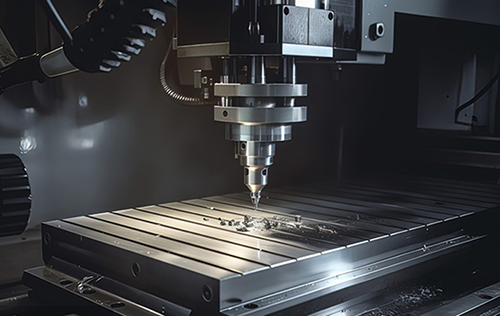
In the field of CNC machining, the number of axes a machine tool can control directly determines its machining capabilities, complexity, and cost structure. 3-axis CNC machining is suitable for simple planar and basic structural parts; 4-axis machining adds rotational capabilities for cylindrical and multi-faceted components; while 5-axis CNC machining enables efficient, high-precision machining of complex surfaces.
However, a higher number of axes does not automatically mean a better choice. For many projects, selecting a machining solution that best fits the part’s geometry and budget is often more important than choosing a machine tool with the highest specifications.
This guide provides a comprehensive comparison of 3‑axis, 4‑axis, and 5‑axis CNC machining in terms of machining capabilities, cost, precision, and application scenarios—helping you identify the solution that best meets your project’s needs.
What Is a Multi-Axis CNC Machine?
A multi-axis CNC machine is a computer‑controlled machining center that moves a cutting tool along multiple axes. Each axis enables movement in a specific direction—typically along the X, Y, and Z planes (horizontal, vertical, and depth). The more axes a machine has, the more complex and intricate parts it can produce. Multi-axis CNC machining allows manufacturers to create parts that would otherwise require several setups, reducing errors and increasing efficiency.
The fundamental differences between 3‑axis, 4‑axis, and 5‑axis CNC milling machines lie in the number of axes they control and the resulting motion capabilities.
3‑Axis CNC Machining: The Industry Workhorse
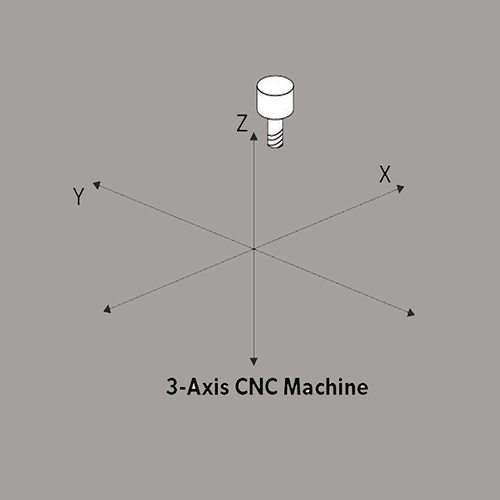
3‑axis CNC machining is the most common and widely used type of CNC milling. In this configuration, the cutting tool moves along three independent linear axes:
X‑axis: Left‑to‑right horizontal movement
Y‑axis: Front‑to‑back movement
Z‑axis: Up‑and‑down vertical movement
With a 3‑axis CNC milling machine, the workpiece remains stationary while the tool moves in three dimensions. This setup is ideal for creating 2.5D geometries, flat surfaces, drilled holes, and threaded features aligned with the primary axes.
Key Characteristics:
Simple setup and programming – Basic G‑code commands are sufficient for most operations
Lower equipment cost – 3‑axis machining centers are the most affordable option
Multiple setups required – Machining multiple faces of a part requires repositioning or re‑fixturing
Limited geometry – Cannot machine undercuts, angled features, or compound angles without specialized tooling
Best Applications:
Flat and prismatic parts
Simple brackets and housings
Drilling and tapping operations
Prototyping and low‑volume production with simple geometries
4‑Axis CNC Machining: Adding Rotation for Efficiency
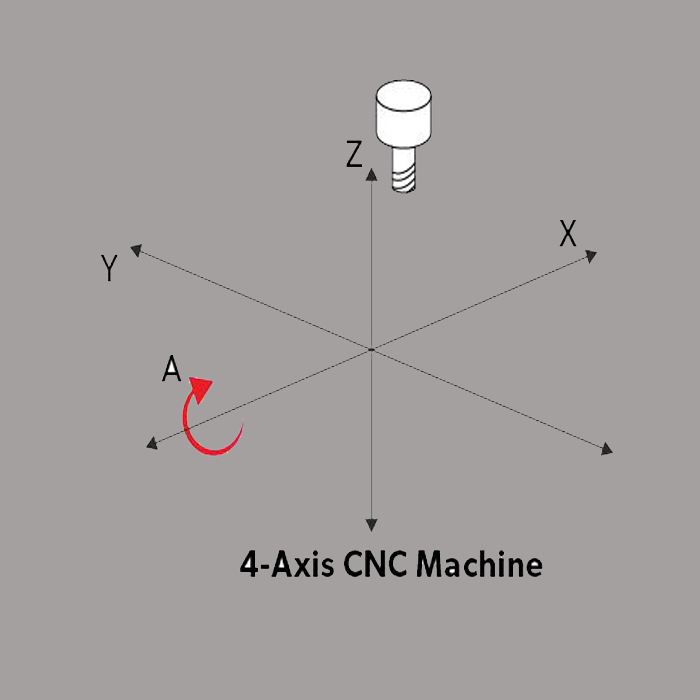
4‑axis CNC machining builds upon 3‑axis capabilities by adding a rotational axis—typically the A‑axis, which rotates around the X‑axis. This is often referred to as “3+1” machining, where the three linear axes are supplemented by one rotary motion.
The additional rotary axis allows the workpiece to be rotated during machining, enabling machining on multiple faces in a single setup. This eliminates the need for manual repositioning between operations, reducing setup time and improving accuracy.
Key Characteristics:
Fewer setups – Machine multiple sides of a part without unclamping
Moderate cost increase – 4‑axis machines typically cost 30%–50% more than 3‑axis equivalents
More complex programming – Requires consideration of rotary axis movements
Ideal for cylindrical and multi‑face parts – Enables machining of features around a part’s circumference
Best Applications:
Cylindrical components and shafts
Parts with features on multiple sides
Medium‑volume production where setup reduction justifies the added cost
5‑Axis CNC Machining: The Ultimate in Precision and Complexity
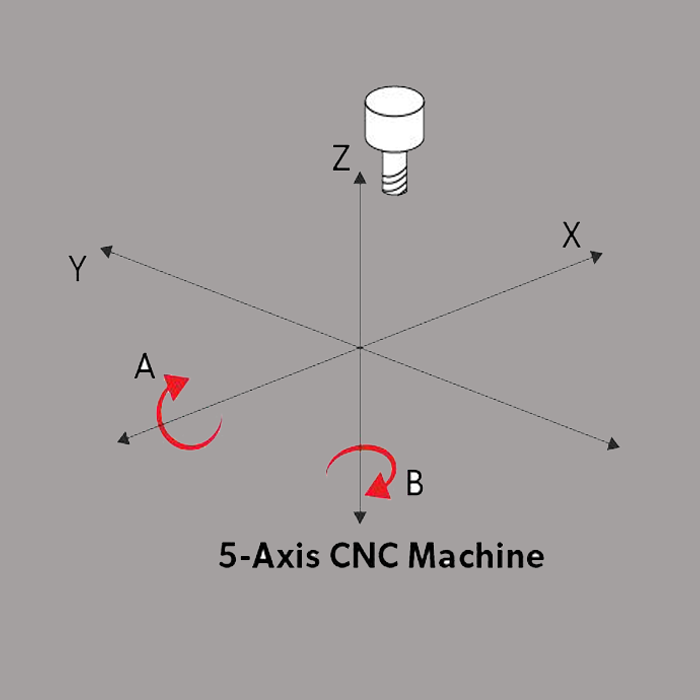
5‑axis CNC machining represents the most advanced level of CNC milling capability. A 5‑axis machine adds two rotational axes (typically A and B, or A and C) to the three linear axes, allowing the cutting tool to approach the workpiece from virtually any direction.
There are two primary 5‑axis machining strategies:
3+2 (Indexed) Machining
In 3+2 machining, the two rotary axes position the workpiece at a fixed angle and lock into place. The actual cutting then occurs using only the three linear axes. This approach is sometimes called “positional 5‑axis” and offers a significant productivity improvement over 3‑axis machining with lower programming complexity than full simultaneous 5‑axis.
Simultaneous 5‑Axis Machining
In simultaneous 5‑axis machining, all five axes move together during the cutting operation. The tool continuously adjusts its orientation to follow complex surface geometries, enabling the machining of highly sculpted, freeform surfaces in a single operation.
Key Characteristics:
Single‑setup machining – Complete complex parts in one clamping
Superior precision – Tolerances as tight as ±0.0005″
Excellent surface finishes – Continuous tool orientation minimizes tool marks
Highest equipment cost – 5‑axis machines are significantly more expensive than 3‑ or 4‑axis equivalents
Advanced programming required – Requires sophisticated CAM software and skilled programmers
Best Applications:
Complex, high‑precision parts requiring tight tolerances
Comparative Table: 3-Axis, 4-Axis, vs. 5-Axis CNC Machines
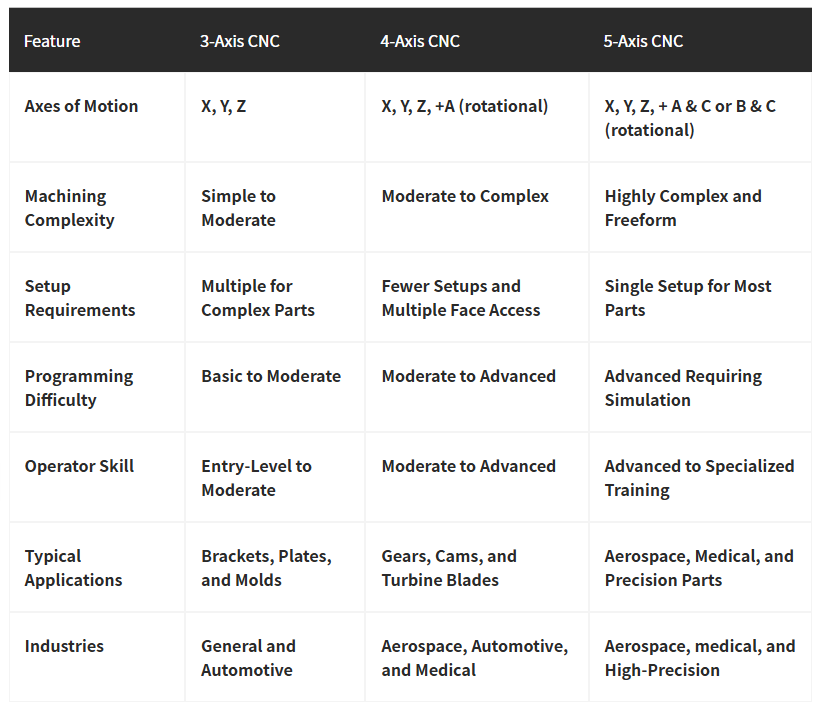
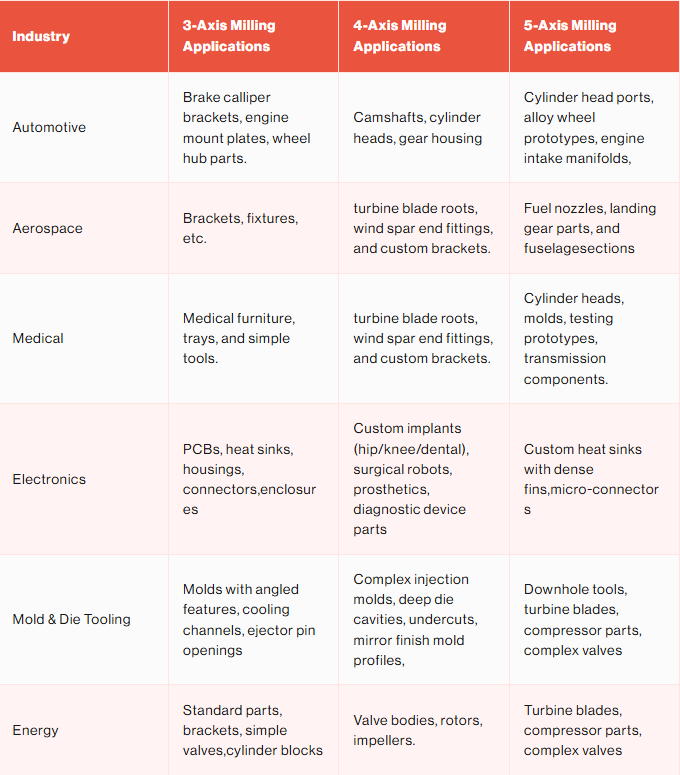
The following table illustrates the application difference between 3, 4 & 5 Axis CNC Milling across common industries with examples;
3‑Axis vs. 4‑Axis vs. 5‑Axis CNC: Cost Comparison
When comparing the costs of 3‑axis, 4‑axis, and 5‑axis CNC machining, one cannot rely solely on the hourly machine rate. Factors such as programming, setup, and production efficiency must also be considered。
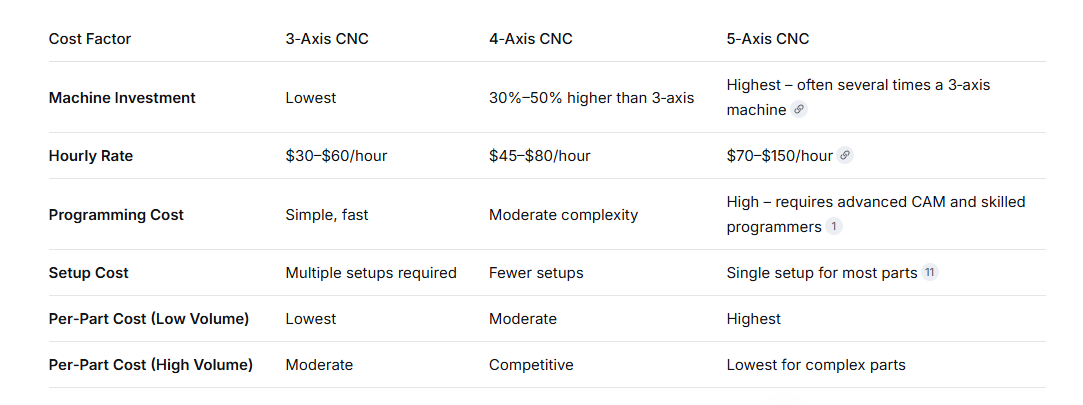
In prototyping and small‑batch production, programming and setup costs account for a significant portion of the total cost. Choosing an inappropriate machining method may lead to increased overall costs. For mass production, while 5‑axis machining has the highest equipment cost, it often reduces the cost per part due to fewer setups and higher machining efficiency.
Therefore, the most economical solution is not necessarily the one with the fewest or most axes, but rather the machining method best suited to the part’s geometry and production requirements.
How to Choose Between 3‑Axis, 4‑Axis, and 5‑Axis CNC Machining
There is no single “best” option among 3‑axis, 4‑axis, and 5‑axis CNC machining. The right choice depends on your part’s geometry, precision requirements, production volume, and budget.
1. Design Complexity
Consider what geometrical features your design requires:
Simple 2.5D and flat features → 3‑axis CNC machining is sufficient
Multi‑face features, cylindrical geometry → 4‑axis CNC machining
Complex surfaces, undercuts, irregular contours → 5‑axis CNC machining
Examples requiring 5‑axis: turbine blades, impellers, medical implants, plastic molding tools
2. Tolerance and Precision Requirements
General tolerances (±0.001″) → 3‑axis or 4‑axis CNC machining can deliver acceptable results
Tight tolerances (±0.0005″) with excellent repeatability → 5‑axis CNC machining is required
3. Application Industry
Aerospace, medical, defense – Precision‑sensitive industries typically require 4‑axis or 5‑axis CNC machining
Automotive, general manufacturing – 3‑axis or 4‑axis CNC machining often suffices
4. Production Volume and Cost
Low volume, simple designs → 3‑axis CNC machining offers the best cost‑effectiveness
Medium volume (10–500 pieces) → 4‑axis CNC machining provides the best balance of cost and capability
High volume, complex parts → 5‑axis CNC machining reduces per‑part cost through efficiency gains
5. A Note on 3+2 vs. Full 5‑Axis
For many parts, 3+2 (indexed) 5‑axis machining offers an excellent middle ground. It provides the setup reduction benefits of 5‑axis capability without the programming complexity of full simultaneous 5‑axis. If your part requires machining on multiple faces at fixed angles but does not require continuous tool orientation changes, 3+2 machining may be the most cost‑effective solution.
Conclusion
Selecting the right CNC machining solution requires careful evaluation of your part’s geometry, tolerance requirements, production volume, and budget constraints.
3‑axis CNC machining is the most cost‑effective choice for simpler designs and lower production volumes
4‑axis CNC machining offers greater flexibility for cylindrical and multi‑face parts with moderate cost increase
5‑axis CNC machining delivers the highest precision and capability, making it the best option for complex, high‑value components in aerospace, medical, and other precision‑sensitive industries
At Ofinitihardware (www.ofinitihardware.com), we offer a full range of multi‑axis CNC machining solutions to handle virtually any part complexity. With deep expertise in laser cutting, stamping, die casting, CNC machining, and surface finishing—backed by over a decade of experience in the hardware manufacturing industry—we have the technical knowledge and production capacity to meet your needs.
Whether you are working with straightforward designs or require precision machining for sophisticated components, our team can help you select the optimal manufacturing approach. Contact us today to discuss your project and receive a professional consultation on the best CNC machining solution for your specific requirements.