

CNC Turning vs Milling: Key Differences, Costs, Applications & How to Choose
Introduction
When a component requires tight tolerances, repeatable dimensions, and consistent surface quality, choosing the right CNC machining process is essential. Two of the most widely used methods are CNC turning and CNC milling.
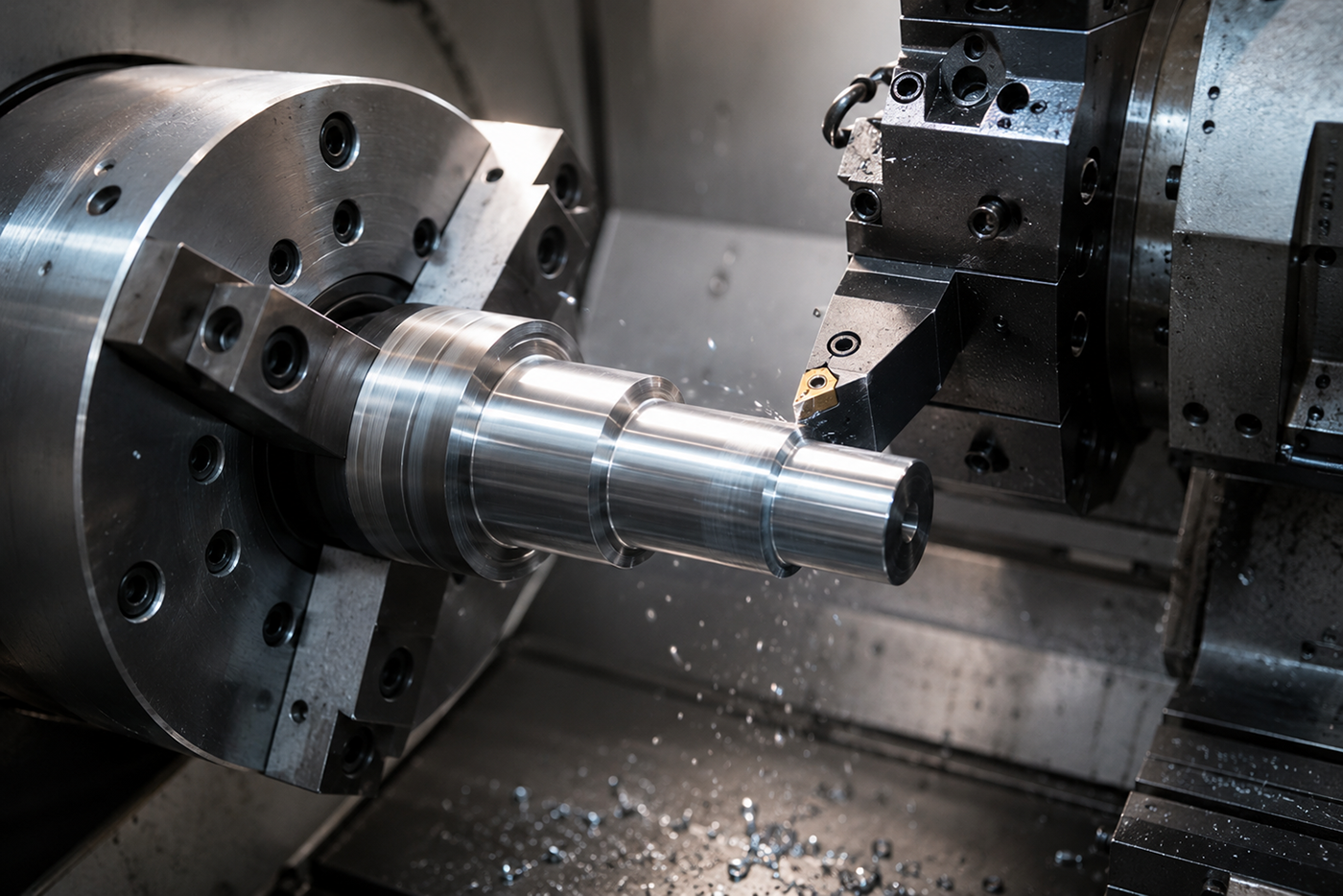
Although both processes use computer-controlled machines to remove material, they work in fundamentally different ways. In CNC turning, the workpiece rotates while a cutting tool removes material. In CNC milling, the workpiece is generally fixed while a rotating cutting tool moves along multiple axes.
For OEM manufacturers, engineers, and procurement teams, understanding CNC turning vs milling can help control production costs, avoid design limitations, and achieve the required quality and lead time.
In this guide, we explain how CNC turning and milling work, compare their capabilities and applications, and show how to choose the right CNC machining process—or combination of processes—for your project.
What Is CNC Milling?
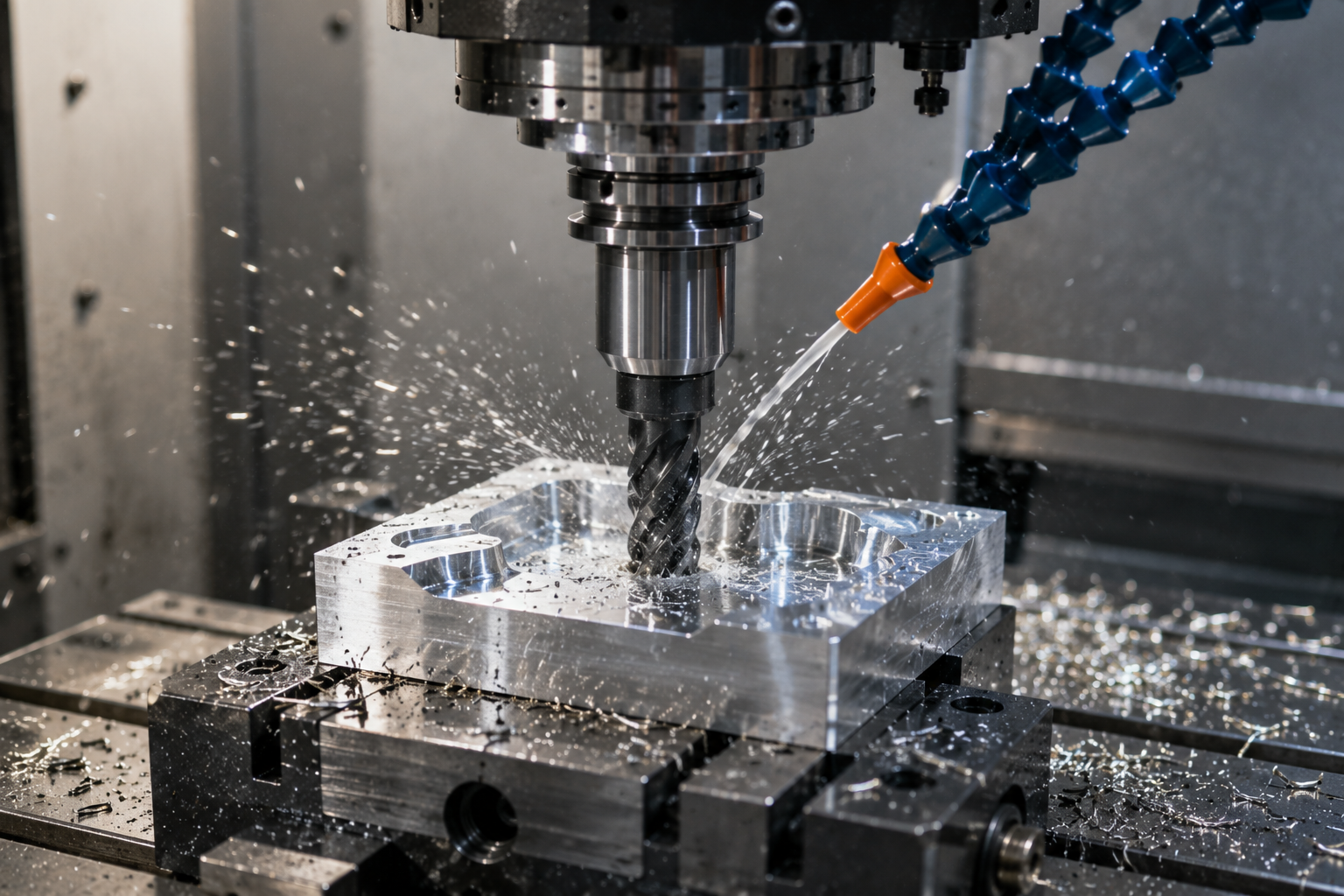
CNC milling is a subtractive manufacturing process in which a rotating cutting tool removes material from a stationary workpiece. The machine follows instructions generated from digital CAD and CAM data to produce precise features according to the component drawing.
Depending on the machine configuration, CNC milling can operate on 3, 4, or 5 axes, allowing manufacturers to machine surfaces from different directions and produce increasingly complex geometries.
Unlike conventional machining, CNC milling can repeat the same tool paths with a high degree of consistency. This makes it suitable for both prototype production and high-volume manufacturing.
How CNC Milling Works
The typical CNC milling workflow includes several stages:
1.CAD design: The component is created or supplied as a 2D drawing or 3D CAD model.
2.DFM review: Engineers evaluate material, tolerances, wall thickness, tool access, and other manufacturing considerations.
3.CAM programming: CAM software converts the digital design into machine tool paths.
4.Workholding: The workpiece is securely fixed to the machine table or fixture.
5.Tool selection: Appropriate end mills, drills, face mills, or other cutting tools are selected
6.Machining: The rotating tools remove material according to programmed tool paths.
7.Inspection: Critical dimensions and surface characteristics are checked against the drawing.
Modern CNC milling machines can perform operations such as face milling, slot milling, pocketing, drilling, boring, contouring, chamfering, and thread milling.
This makes milling particularly valuable when a component contains holes, pockets, slots, angled surfaces, irregular profiles, or multiple intersecting features.
Common CNC Milling Operations
Different milling operations are selected according to the geometry and functional requirements of the part.
Face Milling
Face milling creates a flat and uniform surface by removing material from the top or face of the workpiece. It is often used to establish accurate reference surfaces or improve surface finish.
End Milling
End mills are used to machine pockets, contours, steps, slots, and complex profiles. This is one of the most versatile operations in CNC milling.
Slot Milling
Slot milling produces precise grooves, channels, keyways, and other recessed features. These features are commonly found in mechanical components and assemblies.
Drilling
CNC milling machines can accurately create holes with controlled diameter, depth, and position. Additional operations such as countersinking and counterboring may also be performed.
Boring
Boring enlarges or corrects an existing hole to achieve a more precise diameter and alignment.
Thread Milling
Thread milling uses a rotating cutting tool to produce internal or external threads. It can be useful when working with larger thread sizes, difficult materials, or applications requiring controlled thread geometry.
Contour and 3D Milling
Multi-axis CNC milling allows tools to follow complex surfaces and profiles. This capability is particularly useful for custom machine components, tooling, housings, molds, fixtures, and precision industrial parts.
What Is CNC Turning?
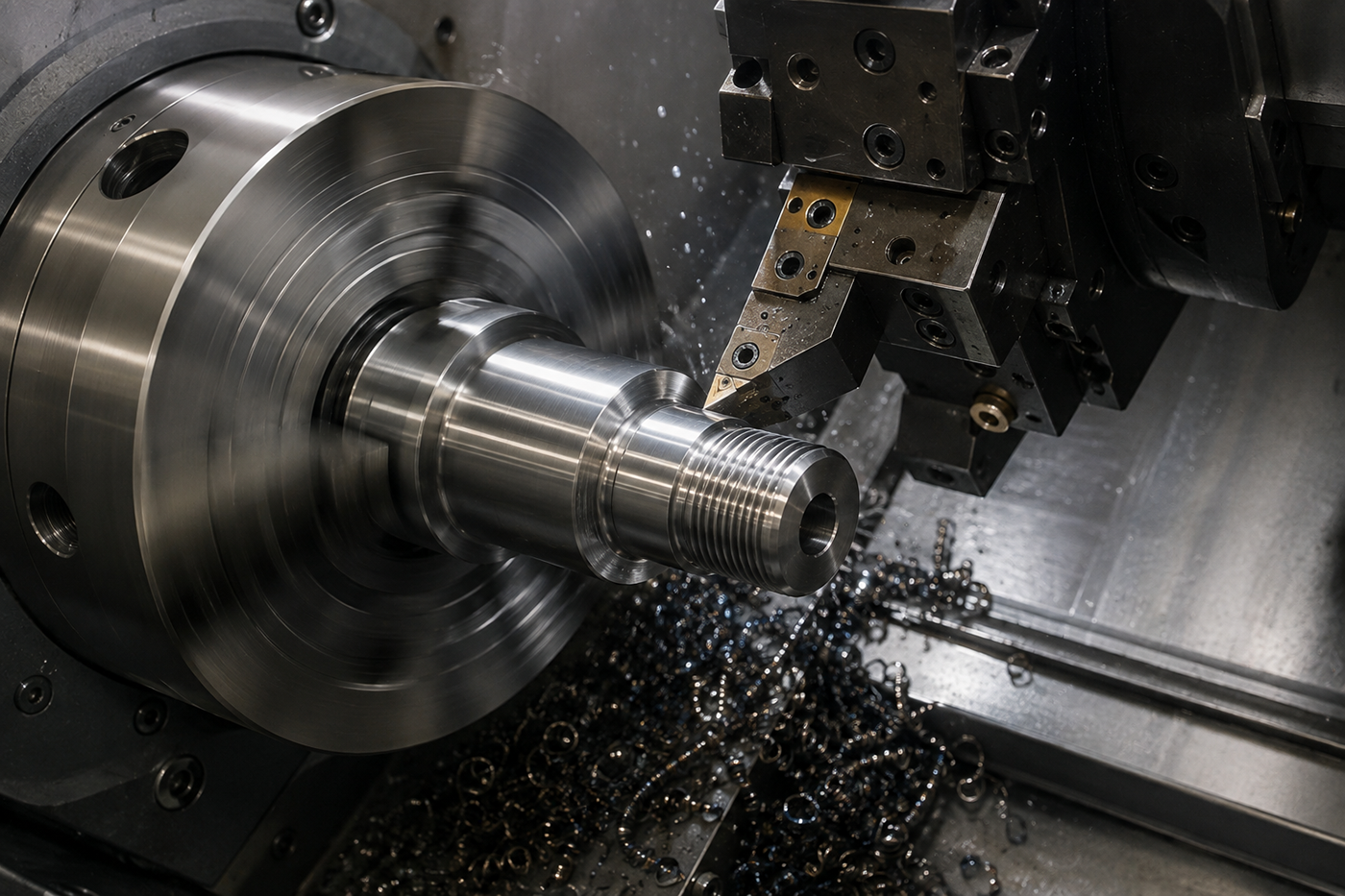
CNC turning is a machining process in which the workpiece rotates on a spindle while a cutting tool removes material from its surface.
The process is particularly effective for producing round, cylindrical, conical, or symmetrical components.
A CNC turning center can follow programmed tool paths to perform operations such as external turning, facing, boring, threading, grooving, and drilling.
Compared with manual lathes, CNC turning provides automated tool movement and programmable machining parameters. This allows manufacturers to produce large quantities of components with consistent dimensions and repeatable quality.
How CNC Turning Works
A typical CNC turning process follows these steps:
A CAD drawing or 3D model defines the required component.
Engineers review the design and select the appropriate material and machining strategy.
CAM software generates the CNC program.
The raw bar, tube, or workpiece is secured in the spindle or chuck.
The spindle rotates the workpiece at the programmed speed.
Cutting tools move along the required axes to remove material.
Additional operations such as drilling, threading, or grooving may be performed.
The finished component is inspected before shipment.
Advanced CNC turning centers can incorporate live tooling, sub-spindles, and multi-axis capabilities, allowing certain milling and drilling operations to be completed within the same machine setup.
This can reduce additional setups and improve dimensional consistency for complex turned components.
Common CNC Turning Operations
External Turning
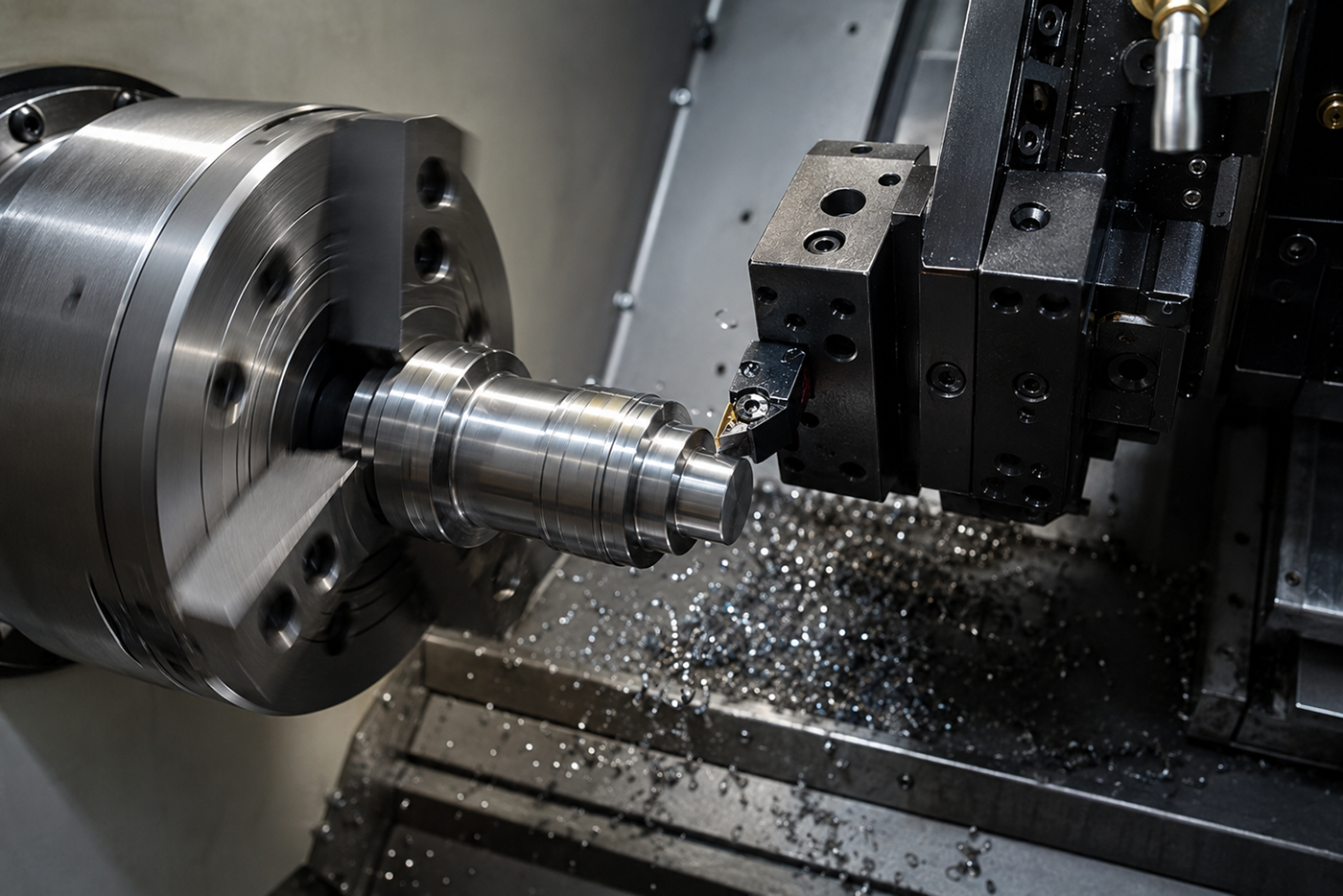
External turning removes material from the outside diameter of a rotating workpiece to create a specific cylindrical or tapered dimension.
Facing
Facing removes material from the end of a workpiece to create a flat, accurately positioned surface.
Boring
Boring enlarges an existing hole and improves its dimensional accuracy and alignment.
Drilling
Drilling creates holes along the rotational axis or, depending on the machine configuration, at other programmed positions.
Threading
CNC threading produces accurate internal or external threads for fastening and assembly.
Grooving
Grooving creates narrow recesses on the external or internal surface of a component.
Parting
Parting, also called cutoff, separates the finished component from the remaining bar stock.
Knurling
Knurling creates a patterned surface that can improve grip or provide a functional surface texture.
These operations make CNC turning highly efficient for shafts, pins, bushings, spacers, fittings, threaded components, rollers, and other rotational parts.
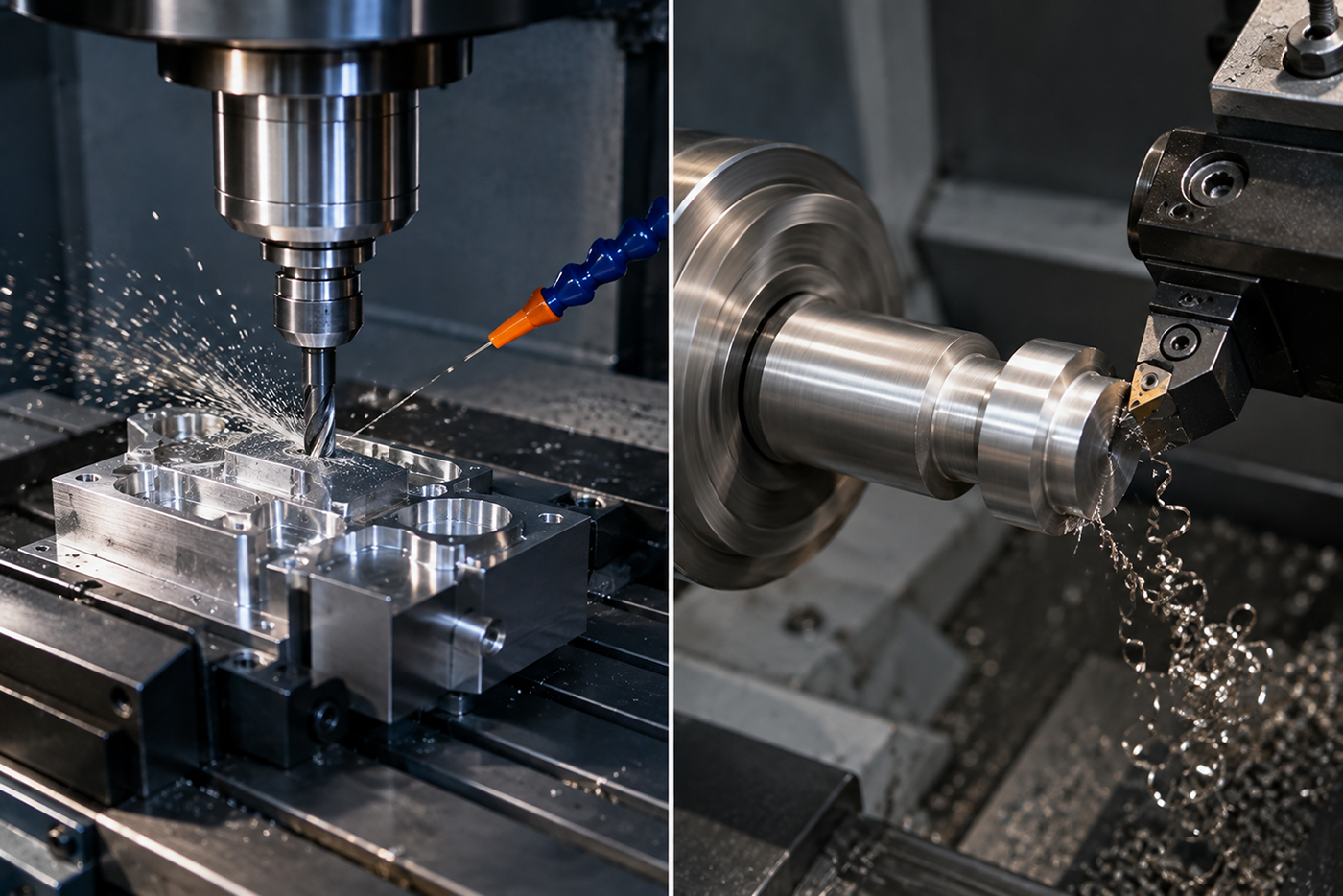
CNC Turning vs Milling: The Key Differences
The easiest way to understand the difference is to focus on what rotates during machining.
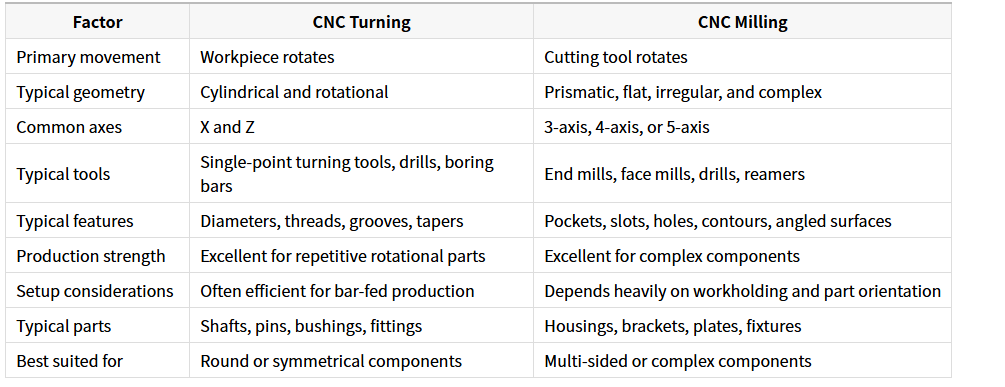
The two processes are not competitors in every situation. Many industrial components require both turning and milling to achieve their final geometry.
CNC Turning vs Milling: Which Process Is More Accurate?
Accuracy depends on much more than whether a component is turned or milled.
Machine rigidity, tool condition, material properties, thermal stability, workholding, programming strategy, and inspection equipment all influence the final result.
Both CNC turning and CNC milling can achieve tight tolerances when the machine, tooling, process parameters, and inspection methods are properly selected.
The more important question is whether the selected process is appropriate for the component geometry.
For example:
A precision shaft with multiple diameters is naturally suited to CNC turning.
A housing with pockets and mounting holes is generally better suited to CNC milling.
A component containing both rotational and milled features may benefit from a CNC turn-mill process.
For critical dimensions, the manufacturing supplier should review the drawing before production and determine the appropriate machining strategy.
CNC Turning vs Milling: How Does Part Geometry Affect the Choice?
Part geometry is usually the first factor engineers consider when choosing between CNC turning and milling.
Choose CNC Turning for Rotational Geometry
CNC turning is generally the better choice when the component is primarily symmetrical around a central axis.
Typical examples include:
Shafts
Pins
Bushings
Spacers
Rollers
Threaded fittings
Connectors
Sleeves
Precision fasteners
If most of the material needs to be removed from the outside or inside diameter, turning can provide an efficient machining route.
Choose CNC Milling for Complex Geometry
CNC milling is better suited to components with features distributed across multiple surfaces.
Typical examples include:
Machine brackets
Aluminum housings
Custom fixtures
Mounting plates
Industrial components
Sensor housings
Mechanical blocks
Tooling components
If a component requires pockets, slots, multiple hole patterns, angled surfaces, or irregular external profiles, milling is usually more appropriate.
Use Turn-Mill Machining for Hybrid Components
Some components combine both rotational and prismatic features.
For example, a part may require:
A precision cylindrical outer diameter
Internal boring
External threads
Cross-drilled holes
Milled flats
Slots or keyways
Instead of moving the component between multiple machines, a CNC turn-mill center may complete several operations in one setup.
This can reduce handling, improve positional accuracy, and shorten production time.
CNC Turning vs Milling: Which Is Faster?
There is no universal answer because machining speed depends on the part geometry, material, quantity, tolerance requirements, tooling, and machine configuration.
However, CNC turning can be extremely efficient for high-volume cylindrical components because the rotating workpiece allows continuous cutting around its circumference.
For complex parts with multiple surfaces and features, CNC milling may require several tool changes and machining orientations. However, advanced multi-axis milling can significantly reduce the number of setups.
For production planning, it is better to evaluate total cycle time rather than simply comparing machine types.
A lower-cost machining operation is not necessarily the most economical option if it requires additional setups, secondary operations, or extensive manual finishing.
CNC Turning vs Milling: Which Process Costs Less?
Cost is another area where oversimplification can lead to the wrong manufacturing decision.
CNC turning is often cost-effective for simple rotational components and larger production quantities, particularly when bar stock and automated production methods can be used efficiently.
CNC milling can become more economical when the part requires complex features that would be difficult or impossible to produce through turning.
The final cost can be influenced by:
Material cost
Material utilization
Machine cycle time
Tool consumption
Number of setups
Programming complexity
Required tolerances
Surface finish
Inspection requirements
Production volume
Secondary operations
Packaging and logistics
Therefore, the cheapest process is not always the one with the lowest hourly machine rate.
The right manufacturing strategy minimizes total cost while maintaining the required quality and performance.
What Materials Can Be CNC Turned or Milled?
Both CNC turning and CNC milling can process a broad range of engineering materials.
Metals
Aluminum and aluminum alloys
Stainless steel
Carbon steel
Alloy steel
Brass
Copper
Bronze
Cast iron
Titanium
Nickel-based alloys
Engineering Plastics
Nylon
PEEK
PTFE
POM/Delrin
Polycarbonate
ABS
The material affects cutting speed, feed rate, tool selection, coolant strategy, chip control, and surface finish.
However, material alone does not determine whether turning or milling should be used. Part geometry remains one of the most important considerations.
An experienced CNC machining manufacturer can recommend the appropriate process after reviewing the material specification together with the drawing and functional requirements.
Applications of CNC Turning
Because of its ability to efficiently produce rotational components, CNC turning is widely used across many industries.
Automotive Manufacturing
CNC turning is commonly used for shafts, bushings, pins, fittings, spacers, and other precision automotive components.
Aerospace
Aerospace components often require tight dimensional control and reliable material performance. CNC turning can be used for precision shafts, connectors, fittings, and other rotational components.
Medical Equipment
Medical manufacturing can require small, precise components such as pins, sleeves, bone-related hardware, and instrument components.
Industrial Equipment
CNC turning is widely used for components in pumps, motors, automation systems, machinery, valves, and industrial assemblies.
Electronics and Electrical Products
Precision turned components can be used for connectors, terminals, shafts, threaded inserts, and other small hardware components.
Applications of CNC Milling
CNC milling is particularly useful when a component has multiple surfaces or complex features.
Industrial Machinery
Milled components include machine brackets, mounting plates, housings, fixtures, structural components, and custom machine parts.
Automation and Robotics
Robotic systems often require accurately machined brackets, mounting interfaces, sensor housings, tooling components, and end-effectors.
Electronics
CNC milling can produce custom enclosures, heat sinks, mounting components, and precision housings.
Medical Equipment
Complex medical components can require multi-axis machining to achieve precise surfaces, holes, pockets, and contours.
Aerospace and Defense
Where complex geometries and demanding tolerances are required, multi-axis CNC milling provides greater flexibility for producing advanced components.
Tooling and Fixtures
CNC milling is extensively used for molds, dies, jigs, fixtures, inspection tooling, and production aids.
How to Choose Between CNC Turning and CNC Milling
If you are deciding between CNC turning and milling for a new component, consider these five questions.
1. What Is the Basic Shape?
If the component is primarily cylindrical or rotational, CNC turning is usually the starting point.
If the component is rectangular, irregular, multi-sided, or contains extensive pockets and slots, CNC milling may be more suitable.
2. What Features Does the Part Require?
Review the drawing carefully.
Features such as:
Threads
Diameters
Grooves
Bores
often favor turning.
Features such as:
Pockets
Slots
Flat surfaces
Angled faces
Complex contours
Multi-directional holes
often favor milling.
3. How Many Parts Do You Need?
Production volume can significantly influence the most economical manufacturing strategy.
For high-volume rotational parts, CNC turning may offer excellent productivity. For lower-volume custom parts with complex geometry, CNC milling may provide greater flexibility.
4. What Tolerances Are Critical?
Identify the dimensions that directly affect assembly, movement, sealing, alignment, or product performance.
The machining process should then be selected according to the required tolerance and the geometry associated with that tolerance.
5. Does the Part Need Multiple Processes?
Some designs simply cannot be optimized around a single machining process.
A component may require:
CNC turning → CNC milling → drilling → deburring → surface treatment → inspection
In other cases, a turn-mill machine may combine several operations into a single setup.
This is where DFM analysis and engineering support become valuable before production begins.
Why DFM Matters Before CNC Machining
Selecting CNC turning or milling is only one part of successful manufacturing.
A well-designed component can still become unnecessarily expensive if its geometry creates difficult tool access, excessive material removal, complicated workholding, or unnecessary secondary operations.
A professional Design for Manufacturability (DFM) review can identify these problems before production.
For example, engineers may evaluate:
Tolerance requirements
Material selection
Minimum wall thickness
Hole diameter and depth
Tool accessibility
Corner radii
Thread specifications
Surface finish
Workholding requirements
Machining sequence
Secondary processes
A small design modification made during the engineering stage can sometimes eliminate a major production problem later.
The goal of DFM is not simply to make a part easier to machine—it is to make the entire manufacturing process more reliable and cost-effective.
CNC Turning vs Milling: A Quick Decision Guide
Use this simplified guide when evaluating a new component:
Choose CNC turning when:
The part is primarily cylindrical.
Rotational symmetry dominates the design.
Multiple diameters or grooves are required.
External or internal threads are important.
You need efficient production of repeated rotational components.
Choose CNC milling when:
The part has multiple flat or angled surfaces.
Pockets or slots are required.
Hole patterns exist across different faces.
The geometry is irregular or complex.
Multi-axis machining is needed.
Consider CNC turn-mill machining when:
The part contains both cylindrical and milled features.
Multiple setups would otherwise be necessary.
Positional accuracy between features is critical.
Reducing handling and production time is important.
Ultimately, the best CNC machining process is determined by the complete part requirement—not simply by the machine available.
Conclusion
CNC turning and CNC milling are fundamental technologies in precision manufacturing, but each is suited to different machining requirements.
CNC turning is ideal for cylindrical and rotational components, while CNC milling provides greater flexibility for complex, multi-sided, and irregular geometries.
The right process depends on the part's geometry, material, tolerances, production volume, surface finish, and cost requirements. For more complex components, a combination of turning and milling may provide the most efficient solution.
Working with an experienced custom CNC machining manufacturer can help you select the right process, identify production risks, and optimize the path from prototype to mass production.
Why Choose Ofiniti Hardware for Custom CNC Machining?
At Ofiniti Hardware Industry Co., Ltd., we provide integrated custom manufacturing and CNC machining solutions, helping customers turn drawings and product concepts into reliable finished components.
With decades of experience in custom hardware manufacturing, our capabilities include:
CNC Milling
CNC Turning
CNC Swiss Machining
5-Axis CNC Machining
CNC Turn-Mill Machining
Sheet Metal Fabrication
Laser Cutting and Welding
Bending, Stamping, and Powder Coating
This integrated production capability allows us to select the most suitable manufacturing process based on your part geometry, material, tolerances, production volume, and cost requirements.
From Drawing to Finished Part
Our standard workflow is:
Drawing Upload or Engineering Support → Project Review & Quotation → Prototype/Sample → Production & Quality Inspection → Delivery
Our engineering team can review your design for DFM, material selection, machining feasibility, and cost optimization before production.
Whether you need prototypes, small-batch production, or ongoing OEM manufacturing, Ofiniti focuses on consistent quality, reliable delivery, and practical manufacturing solutions.
Have a CNC turning, CNC milling, precision component, custom hardware, or OEM project? Send us your drawings and requirements for an engineering evaluation.
Your drawing is the starting point. We turn it into a reliable finished component.
FAQs About CNC Turning vs Milling
1. What is the main difference between CNC turning and CNC milling?
The primary difference is movement. CNC turning rotates the workpiece while the cutting tool removes material, making it ideal for cylindrical and rotational components. CNC milling rotates the cutting tool while the workpiece is generally fixed, making it suitable for complex profiles, pockets, slots, and multi-sided components.
2. Is CNC turning cheaper than CNC milling?
Not always. CNC turning can be highly economical for simple rotational parts, especially at higher production volumes. CNC milling may be more cost-effective when the component requires complex features that would be difficult to manufacture through turning.
The final price depends on material, geometry, tolerances, production volume, cycle time, tooling, setups, and secondary operations.
3. Can one machine perform both CNC turning and milling?
Yes. CNC turn-mill centers and multi-tasking machines can combine turning, milling, drilling, threading, and other operations in one machine setup.
This can reduce part handling, shorten production time, and improve positional accuracy between different features.
4. Which process is better for complex parts?
For parts with irregular geometry, multiple flat surfaces, pockets, slots, and angled features, CNC milling is generally more suitable.
However, if a complex component contains both rotational and milled features, turn-mill machining or a combination of CNC turning and CNC milling may be the better solution.
5. What materials can be machined using CNC turning and CNC milling?
Both processes can machine many metals and engineering plastics, including aluminum, stainless steel, carbon steel, brass, copper, bronze, titanium, PEEK, nylon, POM, PTFE, and other engineering materials.
The appropriate cutting tools, speeds, feeds, coolant strategy, and machining method depend on the specific material and part design.
6. Which process is better for high-volume production?
CNC turning can be particularly efficient for high-volume production of cylindrical or rotational parts. However, CNC milling can also be highly productive for complex components when the machine configuration, tooling, workholding, and production strategy are optimized.
Production volume should therefore be considered together with part geometry.
7. Can CNC turning and milling achieve tight tolerances?
Yes. Both CNC turning and CNC milling can produce precision components with tight tolerances when the machine, tooling, programming, workholding, environmental conditions, and inspection methods are properly controlled.
The achievable tolerance should always be evaluated against the specific material, geometry, dimension, and production requirements.
8. How do I know whether my part needs CNC turning or CNC milling?
Start with the geometry. Cylindrical and rotational components generally favor CNC turning, while complex, multi-sided, or irregular components generally favor CNC milling.
If the component combines both types of features, a manufacturer may recommend turn-mill machining or multiple CNC processes.
The most reliable approach is to provide the manufacturer with your 2D drawing, 3D CAD model, material specification, tolerance requirements, surface finish, and expected quantity for an engineering review.
9. Can Ofiniti manufacture both CNC turned and CNC milled parts?
Yes. Ofiniti provides CNC turning, CNC milling, CNC Swiss machining, 5-axis CNC machining, CNC turn-mill machining, and screw machining, supported by additional fabrication and finishing capabilities.
This allows us to provide a more integrated manufacturing solution for OEM and custom hardware projects.
10. Can I send my drawing to Ofiniti for a machining evaluation?
Yes. If you have a drawing, CAD model, sample, or even a preliminary concept, our engineering team can review the requirements and determine a suitable manufacturing process.
Send us your project requirements and let us evaluate the best way to manufacture your part.